Quote by Robbin Williams on Art Movie Oh Caption My Captain
| O Captain! My Captain! | |
|---|---|
| by Walt Whitman | |
 Printed copy of "O Captain! My Captain!" with revision notes by Whitman, 1888[one] | |
| Written | 1865 |
| First published in | The Sat Press |
| Subject(s) | Abraham Lincoln, American Civil War |
| Form | extended metaphor |
| Publication appointment | November 4, 1865 |
| Read online | O Captain! My Captain! at Wikisource |
"O Captain! My Helm!" is an extended metaphor poem written by Walt Whitman in 1865 well-nigh the death of U.S. president Abraham Lincoln. Well received upon publication, the verse form was Whitman's starting time to exist anthologized and the most popular during his lifetime. Together with "When Lilacs Terminal in the Dooryard Blossom'd", "Hush'd Be the Camps To-day", and "This Dust was In one case the Human being", it is 1 of four poems written by Whitman about the death of Lincoln.
During the American Civil State of war, Whitman moved to Washington, D.C., where he worked for the government and volunteered at hospitals. Although he never met Lincoln, Whitman felt a connection to him and was profoundly moved by Lincoln's assassination. "My Captain" was kickoff published in The Saturday Press on November 4, 1865, and appeared in Sequel to Drum-Taps later that yr. He later included information technology in the drove Leaves of Grass and recited the poem at several lectures on Lincoln's death.
Stylistically, the poem is uncharacteristic of Whitman'due south poetry because of its rhyming, song-like menses, and simple "send of state" metaphor. These elements likely contributed to the verse form'due south initial positive reception and popularity, with many celebrating it as 1 of the greatest American works of verse. Critical stance has shifted since the mid-20th century, with some scholars deriding it as conventional and unoriginal. The poem has made several appearances in popular civilization; every bit information technology never mentions Lincoln, it has been invoked upon the death of several other heads of state. It is famously featured in Dead Poets Society (1989) and is often associated with the star of that film, Robin Williams.
Background [edit]
Walt Whitman established his reputation equally a poet in the late 1850s to early 1860s with the 1855 release of Leaves of Grass. Whitman intended to write a distinctly American epic and developed a free poetry style inspired by the cadences of the King James Bible.[two] [3] The brief book, kickoff released in 1855, was considered controversial by some,[iv] with critics especially objecting to Whitman's edgeless depictions of sexuality and the poem's "homoerotic overtones".[5] Whitman's work received meaning attention post-obit praise for Leaves of Grass past American transcendentalist lecturer and essayist Ralph Waldo Emerson.[6] [vii]
At the first of the American Civil State of war, Whitman moved from New York to Washington, D.C., where he held a series of government jobs—offset with the Ground forces Paymaster's Office and later with the Bureau of Indian Affairs.[eight] [9] He volunteered in the army hospitals as a nurse.[10] Whitman's poetry was informed by his wartime experience, maturing into reflections on death and youth, the brutality of war, and patriotism.[eleven] Whitman'due south brother, Union Regular army soldier George Washington Whitman, was taken prisoner in Virginia in September 1864, and held for v months in Libby Prison, a Confederate prisoner-of-state of war military camp near Richmond.[12] On February 24, 1865, George was granted a furlough to return home considering of his poor health, and Whitman travelled to his mother'due south home in New York to visit his brother.[13] While visiting Brooklyn, Whitman contracted to accept his drove of Civil State of war poems, Drum-Taps, published.[14] In June 1865, James Harlan, the Secretarial assistant of the Interior, plant a copy of Leaves of Grass and, considering the collection vulgar, fired Whitman from the Bureau of Indian Affairs.[xv]
Whitman and Lincoln [edit]
Although they never met, Whitman saw Abraham Lincoln several times between 1861 and 1865, sometimes at close quarters. The outset time was when Lincoln stopped in New York Metropolis in 1861 on his manner to Washington. Whitman noticed the President-elect'due south "hitting appearance" and "unpretentious nobility," and trusted Lincoln's "supernatural tact" and "idiomatic Western genius."[16] [17] He admired the President, writing in Oct 1863, "I love the President personally."[18] Whitman considered himself and Lincoln to be "afloat in the same stream" and "rooted in the same ground."[16] [17] Whitman and Lincoln shared similar views on slavery and the Wedlock, and similarities take been noted in their literary styles and inspirations. Whitman afterward declared that "Lincoln gets almost nearer me than anybody else."[16] [17]
There is an account of Lincoln'southward reading Whitman'south Leaves of Grass poetry collection in his office,[19] and another of the President's saying "Well, he looks similar a human," upon seeing Whitman in Washington, D.C.[xx] "The truth of both these stories is hard to establish."[21] Lincoln's death on April 15, 1865, greatly moved Whitman, who wrote several poems in tribute to the fallen President. "O Helm! My Captain!", "When Lilacs Terminal in the Dooryard Bloom'd", "Hush'd Be the Camps To-Day", and "This Dust Was Once the Man" were all written on Lincoln's death. While these poems practise not specifically mention Lincoln, they plough the assassination of the President into a sort of martyrdom.[sixteen] [17]
Text [edit]

Autographed off-white copy of Whitman'south poem—signed and dated March 9, 1887—as published in 1881
O Captain! My Captain! our fearful trip is done;
The send has weather'd every rack, the prize nosotros sought is won;
The port is near, the bells I hear, the people all exulting,
While follow optics the steady keel, the vessel grim and daring:
Simply O heart! centre! heart!
O the bleeding drops of red,[a]
Where on the deck my Captain lies,
Fallen cold and dead.O Captain! My Captain! ascension up and hear the bells;
Ascent up—for you the flag is flung—for you lot the bugle trills;
For you bouquets and ribbon'd wreaths—for you the shores a-crowding;
For y'all they call, the swaying mass, their eager faces turning;
Hither captain! love father!
This arm beneath your head;[b]
Information technology is some dream that on the deck,
Y'all've fallen cold and dead.My Helm does not answer, his lips are pale and still;
My begetter does not feel my arm, he has no pulse nor will;
The ship is anchor'd safe and sound, its voyage closed and washed;
From fearful trip, the victor send, comes in with object won;
Exult, O shores, and band, O bells!
Only I, with mournful tread,
Walk the deck my captain lies,[c]
Fallen common cold and dead.
Publication history [edit]
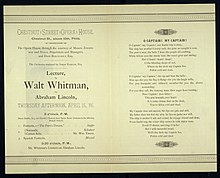
Whitman's lecture on Lincoln, invitation, 1886
Literary critic Helen Vendler thinks it likely that Whitman wrote the poem before "When Lilacs Last in the Dooryard Bloom'd", considering it a straight response to "Hush'd Be the Camps To-Twenty-four hour period".[23] An early draft of the poem is written in gratuitous poetry. [24] "My Captain" was first published in The Saturday Press on November 4, 1865.[d] [xv] [26] Effectually the aforementioned time, information technology was included in Whitman's book, Sequel to Drum-Taps—publication in The Sat Printing was considered a "teaser" for the book. Although Sequel to Pulsate-Taps was first published in early October 1865,[27] the copies were non ready for distribution until Dec.[28] The first publication of the poem had dissimilar punctuation than Whitman intended, and he corrected before its side by side publication.[29] It was too included in the 1867 edition of Leaves of Grass.[15] [30] Whitman revised the poem several times during his life,[31] including in his 1871 collection Passage to Bharat. Its terminal republication by Whitman was in the 1881 edition of Leaves of Grass.[30]
Whitman's friend Horace Traubel wrote in his book With Walt Whitman in Camden that Whitman read a newspaper article that said "If Walt Whitman had written a volume of My Captains instead of filling a scrapbasket with waste and calling information technology a volume the world would be amend off today and Walt Whitman would take some alibi for living."[32] Whitman responded to the article on September 11, 1888, saying: "Damn My Captain[...] I'm most sorry I ever wrote the poem," though he admitted that it "had sure emotional immediate reasons for being".[32] [33] In the 1870s and 1880s, Whitman gave several lectures over eleven years on Lincoln's expiry. He ordinarily began or concluded the lectures by reciting "My Helm", despite his growing prominence meaning he could have read a unlike poem.[34] [35] [36] [29] In the belatedly 1880s, Whitman earned money by selling autographed copies of "My Helm"—purchasers included John Hay, Charles Aldrich, and S. Weir Mitchell.[37]
Style [edit]
The poem rhymes using an AABBCDED rhyme scheme,[38] and is designed for recitation.[39] It is written in ix quatrains, organized in three stanzas. Each stanza has ii quatrains of four seven-beat lines, followed by a four-line refrain, which changes slightly from stanza to stanza, in a tetrameter/trimeter ballad crush.[23] [40] [41] Historian Daniel Mark Epstein wrote in 2004 that he considers the structure of the poem to exist "uncharacteristically mechanical, formulaic".[42] He goes on to describe the poem as a conventional ballad, comparable to Samuel Taylor Coleridge's writing in "The Rime of the Ancient Mariner" and much of Alfred, Lord Tennyson's work, specially "In Memoriam A.H.H."[41] Literary critic Jerome Loving wrote to the opposite upshot in 1999, saying that the structure gave "My Captain" a "sing-song" quality, evocative of folk groups similar the Hutchinson Family Singers and Cheney Family Singers.[36] [43] The scholar Ted Genoways argued that the poem retains distinctive features characteristic to Whitman, such as varying line length.[38] Whitman very rarely wrote poems that rhymed;[due east] in a review gimmicky to Whitman, The Atlantic suggested that Whitman was rising "higher up himself" by writing a poem dissimilar his others. The author elaborated that, while his previous work had represented "unchecked nature", the rhymes of "My Helm" were a sincere expression of emotion.[45]
The writer Frances Winwar argued in her 1941 volume American Giant: Walt Whitman and His Times that "in the uncomplicated ballad rhythm shell the centre of the folk".[46] Vendler concludes that Whitman's use of a simple manner is him saying that "soldiers and sailors have a right to verse written for them". Using elements of popular poesy enabled Whitman to create a verse form that he felt would be understood by the general public.[23] [40] In 2009, bookish Amanda Gailey argued that Whitman—who, writing the poem, had merely been fired from his government job—adopted a conventional style to attract a wider audience. She added that Whitman wrote to heal the nation, crafting a verse form the country would find "ideologically and aesthetically satisfactory". [47] William Pannapacker, a literature professor, similarly described the poem in 2004 as a "calculated critical and commercial success".[48] In 2003, the author Daniel Aaron wrote that "Death enshrined the Commoner [Lincoln], [and] Whitman placed himself and his piece of work in the reflected limelight".[49] As an elegy to Lincoln, the English professor Religion Barrett wrote in 2005 that the mode makes information technology "timeless", following in the tradition of elegies like "Lycidas" and "Adonais".[50]
Reception [edit]
The poem was Whitman's nigh popular during his lifetime, and the merely 1 to be anthologized before his decease.[33] The historian Michael C. Cohen noted that "My Helm" was "carried beyond the express circulation of Leaves of Grass and into the pop heart"; its popularity remade "history in the form of a carol".[51] Initial reception to the poem was very positive. In early on 1866, a reviewer in the Boston Commonwealth wrote that the verse form was the nearly moving chant for Lincoln ever written, [24] [52] adding that Drum Taps "will do much[...] to remove the prejudice confronting Mr. Whitman in many minds".[52] Similarly, after reading Sequel to Drum Taps, the author William Dean Howells became convinced that Whitman had cleaned the "old channels of their filth" and poured "a stream of blameless purity" through; he would become a prominent defender of Whitman.[48] [53] 1 of the earliest criticisms of the poem was authored by Edward P. Mitchell in 1881 who considered the rhymes "crude".[54] "My Helm" is considered uncharacteristic of Whitman'due south poetry,[55] [48] and information technology was praised initially every bit a difference from his typical style. Author Julian Hawthorne wrote in 1891 that the poem was touching partially because it was such a stylistic divergence.[56] In 1892, The Atlantic wrote that "My Helm" was universally accepted equally Whitman'south "one swell contribution to the earth's literature",[45] and George Rice Carpenter, a scholar and biographer of Whitman, said in 1903 that the poem was peradventure the all-time work of Civil War poetry, praising its imagery as "beautiful".[57]
Reception remained positive into the early 20th century. Epstein considers information technology to have been one of the 10 most popular English language poems of the 20th century.[58] In his volume Canons by Consensus, Joseph Csicsila reached a similar conclusion, noting that the poem was "one of the ii or three nearly highly praised of Whitman'due south poems during the 1920s and 1930s"; he also wrote that the poem'due south verse grade and emotional sincerity appealed to "more conservative-minded critics".[59] In 1916, Henry B. Rankin,[60] a biographer of Lincoln,[61] wrote that "My Captain" became "the nation's—aye, the world'due south—funeral dirge of our First American".[62] The Literary Assimilate in 1919 deemed it the "most likely to live forever" of Whitman's poems,[63] and the 1936 book American Life in Literature went farther, describing it equally the best American verse form.[64] Author James O'Donnell Bennett echoed that, writing that the poem represented a perfect "threnody", or mourning poem.[65] The poem was not unanimously praised during this flow: one critic wrote that "My Captain" was "more suitable for recitation before an enthusiastically uncritical audience than for its identify in the Oxford Book of English Poesy".[59]
Beginning in the 1920s, Whitman became increasingly respected by critics, and past 1950 he was one of the almost prominent American authors. Poetry anthologies began to include poetry that was considered more than "authentic" to Whitman's poetic way, and, as a result, "My Captain" became less pop. In an assay of poetry anthologies, Joseph Csicsila found that, although "My Captain" had been Whitman'due south well-nigh frequently published verse form, shortly after the end of World War Ii information technology "all but disappeared" from American anthologies, and had "virtually disappeared" later on 1966.[66] William E. Barton wrote in Abraham Lincoln and Walt Whitman, published in 1965, that the poem was "the least like Whitman of anything Whitman ever wrote; nevertheless it is his highest literary monument".[67]
Critical opinion of the poem began to shift in the middle of the 20th century. In 1980, Whitman'due south biographer Justin Kaplan chosen the poem "thoroughly conventional".[33] The literary critic F. O. Matthiessen criticized the verse form, writing in 1941 that its early popularity was an "ample and ironic comment" on how Whitman'due south more authentic poetry could not reach a wide audience. Michael C. Cohen, a literature professor, said Matthiessen's writing exemplified 20th-century opinion on the poem.[68] [51] In the 1997 book A Reader'south Guide to Walt Whitman, scholar Gay Wilson Allen concluded that the poem's symbols were "trite", the rhythm "artificial", and the rhymes "erratic".[28]
Negative perspectives on the poem continued into the 21st century. In 2000, Helen Vendler wrote that because Whitman "was aptitude on registering private response besides every bit the commonage wish expressed in 'Hush'd be the camps', he took on the voice of a single representative crewman silencing his own idiosyncratic vocalisation".[40] Elsewhere, she states that two "stylistic features—its meter and its use of refrain—mark 'O Captain' as a designedly democratic and populist poem".[40] Four years afterwards, Epstein wrote that he struggled to believe that the same writer wrote both "Lilacs" and "O Captain! My Captain!".[69] Poet Robert Pinsky told the New York Times News Service in 2009 that he considered the poem "not very practiced",[70] and a year later on some other poet, C. K. Williams, concluded that the verse form was a "truly atrocious piece of near doggerel triteness" that deserved cheeky criticism.[71] Meanwhile, the 2004 Oxford Encyclopedia of American Literature entry on Whitman suggests that critiques well-nigh the poem'southward rhythm are unfair.[36]
Themes [edit]
Bookish Stefan Schöberlein writes that—with the exception of Vendler—the poem'southward sentimentality has resulted in it beingness mostly "ignored in English speaking academia".[23] Vendler writes that the poem utilizes elements of war journalism, such as "the bleeding drops of red" and "fallen common cold and dead".[40] The verse form has imagery relating to the sea throughout.[72] Genoways considers the all-time "turn of phrase" in the poem to be line 12, where Whitman describes a "swaying mass", evocative of both a funeral and religious service.[72]
The poem'due south nautical references allude to Admiral Nelson'southward expiry at the Battle of Trafalgar.[73]
"Ship of state" metaphor [edit]
The verse form describes the U.s. every bit a ship, a metaphor that Whitman had previously used in "Death in the Schoolhouse-Room".[39] This metaphor of a ship of state has been often used by authors.[74] Whitman himself had written a letter on March 19, 1863, that compared the head of country to a send's captain.[69] Whitman had likewise probable read newspaper reports that Lincoln had dreamed of a ship nether full sail the dark earlier his assassination;[69] the imagery was allegedly a recurring dream of Lincoln's earlier significant moments in his life.[75]
"My Captain" begins by describing Lincoln as the helm of the nation. By the end of the commencement stanza, Lincoln has go America'due south "dear father" every bit his death is revealed ("fallen cold and expressionless").[39] Vendler writes that the poem is told from the betoken of view of a young Matrimony recruit, a "sailor-boy" who considers Lincoln like a "dear father". The American Ceremonious War is almost over and "the prize we sought is almost won;/the port is almost virtually" with crowds awaiting the ship's arrival. Then, Lincoln is shot and dies. Vendler notes that in the showtime 2 stanzas the narrator is speaking to the dead captain, addressing him as "y'all". In the third stanza, he switches to reference Lincoln in the third person ("My captain does non answer").[23] [40] Winwar describes the "roused voice of the people, incredulous at start, so tragically convinced that their Captain lay fallen".[46] Fifty-fifty as the verse form mourns Lincoln, there is a sense of triumph that the send of state has completed its journey.[76] Whitman encapsulates grief over Lincoln's death in one private, the narrator of the verse form.[77]
Cohen argues that the metaphor serves to "mask the violence of the Civil War" and project "that darkening onto the exulting crowds". He concluded that the poem "abstracted the war into social bear upon and commonage sentiment, converting public violence into a retentivity of shared loss by remaking history in the shape of a ballad".[78]
Religious imagery [edit]

In the second and third stanzas, co-ordinate to Schöberlein, Whitman invokes religious imagery, making Lincoln a "messianic figure". Schöberlein compares the imagery of "My Captain" to the Lamentation of Christ, specifically Correggio'south 1525 Degradation. The poem's speaker places its "arm below [Lincoln'south] caput" in the same way that "Mary cradled Jesus" later on his crucifixion. With Lincoln'southward death, "the sins of America are absolved into a religio-sentimental, national family".[39]
In pop culture [edit]
The verse form, which never mentions Lincoln by proper name, has frequently been invoked post-obit the deaths of a head of country. Subsequently Franklin D. Roosevelt died in 1945, role player Charles Laughton read "O Captain! My Captain!" during a memorial radio circulate.[79] When John F. Kennedy was assassinated on Nov 22, 1963, "O Captain! My Captain!" was played on many radio stations, extending the 'ship of state' metaphor to Kennedy.[76] [80] Post-obit the 1995 assassination of Israeli Prime Minister Yitzhak Rabin, the poem was translated into Hebrew and put to music by Naomi Shemer.[81] [82]
The poem appears in the 1989 American moving-picture show Dead Poets Guild.[83] John Keating (played past Robin Williams), an English teacher at the Welton Academy boarding school,[84] introduces his students to the poem in their first class.[85] [86] Keating is later fired from the school. As Keating returns to collect his belongings, the students stand up on their desks and address Keating as "O Captain! My Captain!"[83] The apply of "My Captain" in the film was considered "ironic" by Cohen because the students are taking a stand up confronting "repressive conformity" just using a poem intentionally written to be conventional.[51] Afterward Robin Williams' suicide in 2014, the hashtag "#ocaptainmycaptain" began trending on Twitter and fans paid tribute to Williams by recreating the "O Captain! My Captain!" scene.[83] [87] Luke Buckmaster, a film critic, wrote in The Guardian that "some people, maybe even nigh people, at present associate Whitman's verse first and foremost with a motion picture rather than a poem".[83]
The verse form was prepare to music by Kurt Weill as ane of "Four Walt Whitman Songs" he composed in the 1940s.[88]
The first two verses of the poem are used as part of the libertarian group "The Friends"' oath and the call to rebellion and protest in the 1993 mini-series Wild Palms.
See also [edit]
- Cultural depictions of Abraham Lincoln
Explanatory notes [edit]
- ^ Originally "Not you lot the fiddling spot"[22]
- ^ Originally "This arm I push beneath you"[22]
- ^ Originally "Walk the spot my captain lies"[22]
- ^ The Saturday Press shut downwards around ii weeks after publishing the verse form.[25]
- ^ "My Captain", "The Vocalizer in the Prison" (1869), and "Ethiopia Saluting the Colors" (1871) are considered Whitman's most 'conventional' works.[44]
Citations [edit]
- ^ Whitman, Walt. "Prototype 2 of Walt Whitman Papers: Literary file; Verse; O Captain! My Captain! printed copy with corrections" (1888). Walt Whitman papers. Washington, D.C.: Manuscript Partition, Library of Congress.
- ^ Miller 1962, p. 155.
- ^ Kaplan 1980, p. 187.
- ^ Loving 1999, p. 414.
- ^ "CENSORED: Wielding the Red Pen". University of Virginia Library Online Exhibits . Retrieved October 28, 2020.
- ^ Callow 1992, p. 232.
- ^ Reynolds 1995, p. 340.
- ^ Loving 1999, p. 283.
- ^ Callow 1992, p. 293.
- ^ Peck 2015, p. 64.
- ^ Whitman 1961, pp. 1:68–lxx.
- ^ Loving 1975, p. 18.
- ^ Loving 1999, pp. 281–283.
- ^ Cost & Folsom 2005, p. 91.
- ^ a b c Gailey 2006, p. 420.
- ^ a b c d Griffin, Martin (May iv, 2015). "How Whitman Remembered Lincoln". Opinionator. The New York Times. ISSN 0362-4331. Retrieved October 12, 2020.
- ^ a b c d Eiselein, Gregory (1998). LeMaster, J. R.; Kummings, Donald D. (eds.). 'Lincoln, Abraham (1809–1865)' (Criticism). New York City: Garland Publishing. Retrieved Oct 12, 2020 – via The Walt Whitman Archive.
- ^ Loving 1999, p. 288.
- ^ "A clerk in Lincoln's law office in Springfield recalled that before he became president, Lincoln had read aloud from Leaves of Grass to his office mates." Matteson, John, A Worse Place Than Hell: How the Ceremonious War Boxing of Fredericksburg Changed a Nation, New York: Westward.W. Norton and Company, 2021, p. 309, citing Rankin, Henry B., Personal Recollections of Abraham Lincoln, New York: Putnam, 1916, pp. 125-126.
- ^ Matteson, John, A Worse Place Than Hell, p. 309, citing Donaldson, Thomas, Walt Whitman the Man, New York: Francis P. Harper, 1896, p. 58.
- ^ Matteson, John, A Worse Identify Than Hell, p. 309.
- ^ a b c Epstein 2004, pp. 300–301.
- ^ a b c d e Schöberlein 2018, p. 450.
- ^ a b Gailey 2006, p. 421.
- ^ Kaplan 1980, p. 244.
- ^ Blodgett 1953, p. 456.
- ^ Oliver 2005, p. 77.
- ^ a b Allen 1997, p. 86.
- ^ a b Hoffman, Tyler (2011). "Walt Whitman "Live": Performing the Public Sphere". Walt Whitman Quarterly Review. 28 (4): 193–194. doi:x.13008/2153-3695.1979. ISSN 2153-3695.
- ^ a b Eiselein 1998, p. 473.
- ^ Epstein 2004, p. 301.
- ^ a b Traubel 1908, p. 304.
- ^ a b c Kaplan 1980, p. 309.
- ^ Pannapacker 2004, p. 101.
- ^ Price & Folsom 2005, p. 121.
- ^ a b c Parini 2004, p. 378.
- ^ Stallybrass, Peter (2019). "Walt Whitman'due south Slips: Manufacturing Manuscript". Walt Whitman Quarterly Review. 37 (i): 66–106. doi:10.13008/0737-0679.2361. ISSN 2153-3695.
- ^ a b Genoways 2006, p. 534.
- ^ a b c d e Schöberlein 2018, p. 473.
- ^ a b c d eastward f Vendler, Helen (Wintertime 2000). "Poesy and the Arbitration of Value: Whitman on Lincoln". Michigan Quarterly Review. XXXIX (one). hdl:2027/spo.act2080.0039.101. ISSN 2153-3695.
- ^ a b Epstein 2004, pp. 301–302.
- ^ Epstein 2004, p. 300.
- ^ Loving 1999, p. 287.
- ^ Schwiebert, John Eastward. (1990). "A Delicate Balance: Whitman'due south Stanzaic Poems". Walt Whitman Quarterly Review. vii (3): 116–130. doi:ten.13008/2153-3695.1250. ISSN 2153-3695.
- ^ a b Scudder, Horace Elisha (June 1892). "Whitman". The Atlantic. ISSN 2151-9463. Retrieved Oct 11, 2020.
- ^ a b Coyle 1962, p. 191.
- ^ Gailey 2006, pp. 420–421.
- ^ a b c Pannapacker 2004, p. 22.
- ^ Aaron 2003, p. 71.
- ^ Barrett 2005, p. 87.
- ^ a b c Cohen 2015, p. 163.
- ^ a b Sanborn, Franklin Benjamin (February 24, 1866). "Review of Drum-Taps". The Boston Commonwealth . Retrieved December three, 2020 – via The Walt Whitman Annal. [originally unsigned]
- ^ Loving 1999, p. 305.
- ^ Genoways 2006, pp. 534–535.
- ^ Coyle 1962, p. 235.
- ^ Scharnhorst, Gary (2009). "'I didn't like his books': Julian Hawthorne on Whitman". Walt Whitman Quarterly Review. 26 (3): 153. doi:10.13008/2153-3695.1894. ISSN 2153-3695.
- ^ Coyle 1962, p. 171.
- ^ Epstein 2004, p. 302.
- ^ a b Csicsila 2004, pp. 57–58.
- ^ Coyle 1962, p. 64.
- ^ "Lincoln Biographer Dies; Henry B. Rankin, a student of War President, Lived to Be 90". The New York Times. August 16, 1927. ISSN 0362-4331. Retrieved Dec 29, 2020.
- ^ Rankin 1916, p. 127.
- ^ Wheeler, Edward Jewitt; Funk, Isaac Kaufman; Woods, William Seaver; Draper, Arthur Stimson; Funk, Wilfred John (April 5, 1919). "Walt For Our Day". The Literary Digest. 61: 28–29.
[. . .] the homo in the street will confess that he knows simply one bit of Whitman: 'O Helm! My Helm!' Well, he knows the one that is nigh likely to alive forever.
- ^ Hubbell 1936, p. 155.
- ^ Bennett 1927, p. 350.
- ^ Csicsila 2004, pp. 58–60, 63.
- ^ Barton 1965, p. 174.
- ^ Matthiessen 1968, p. 618.
- ^ a b c Epstein 2004, p. 299.
- ^ Schuessler, Jennifer (December 13, 2009). "Odes to the chief: Poems on presidents rhapsodize, ridicule". Deseret News. ISSN 0745-4724. Retrieved Oct 29, 2020.
- ^ Williams 2010, p. 171.
- ^ a b Genoways 2006, p. 535.
- ^ "Whitman, Walt | Searchable Body of water Literature". sites.williams.edu . Retrieved October sixteen, 2021.
- ^ Podlecki 2011, p. 69.
- ^ Lewis 1994, p. 297.
- ^ a b George, Philip Brandt (December 2003). "Elegy for a fallen leader". American History. 38 (5): 53.
- ^ Krieg 2006, p. 400.
- ^ Cohen 2015, pp. 162–163.
- ^ Brown 2004, p. 124.
- ^ Blake, David Haven (2010). "Los Angeles, 1960: John F. Kennedy and Whitman's Ship of Democracy". Walt Whitman Quarterly Review. 28 (1–2): 63. doi:10.13008/2153-3695.1952. ISSN 2153-3695.
- ^ "Naomi Shemer, 74; Wrote Unofficial Israeli National Anthem". Los Angeles Times. June 29, 2004. ISSN 2165-1736. Retrieved October 12, 2020.
- ^ Saxon, Wolfgang (June 29, 2004). "Naomi Shemer, 74, Poet and Composer, Dies". The New York Times. ISSN 0362-4331. Retrieved Oct 12, 2020.
- ^ a b c d Buckmaster, Luke (July 16, 2019). "Dead Poets Gild: thirty years on Robin Williams' stirring call to 'seize the twenty-four hour period' endures". The Guardian. ISSN 0261-3077. Retrieved October 12, 2020.
- ^ Dimare 2011, p. 119.
- ^ Rush 2012, p. 26.
- ^ Denham, Jess (August thirteen, 2014). "Robin Williams' best Expressionless Poets Club quotes: 'Carpe diem. Seize the twenty-four hour period, boys. Make your lives extraordinary'". The Independent. ISSN 0951-9467. Retrieved October 12, 2020.
- ^ Idato, Michael (August 13, 2014). "Robin Williams death: Jimmy Fallon fights tears, pays tribute with 'Oh Captain, My Captain'". The Sydney Morning Herald. ISSN 0312-6315. Retrieved October 12, 2020.
- ^ "Four Walt Whitman Songs For voice and piano. Texts by Walt Whitman," Kurt Weill Foundation for Music.
General sources [edit]
- Aaron, Daniel (2003). The Unwritten War: American Writers and the Civil War. Tuscaloosa, Alabama: University of Alabama Printing. ISBN978-0-8173-5002-4.
- Allen, Gay Wilson (1997). A Reader'due south Guide to Walt Whitman. Syracuse, New York: Syracuse University Press. ISBN978-0-8156-0488-4.
- Barton, William Due east. (1965) [1928]. Abraham Lincoln and Walt Whitman. Port Washington, New York: Kennikat Press. ISBN9780804600187. OCLC 1145780794.
- Barrett, Faith (2005). "Addresses to a Divided Nation: Images of War in Emily Dickinson and Walt Whitman". Arizona Quarterly: A Journal of American Literature, Culture, and Theory. 61 (iv): 67–99. doi:ten.1353/arq.2005.0005. ISSN 1558-9595. S2CID 161131368.
- Bennett, James O'Donnell (1927). Much Loved Books: Best Sellers of the Ages. New York Urban center: Boni and Liveright. OCLC 1374171.
- Blodgett, Harold W. (1953). The Best of Whitman. New York City: Ronald Printing Company. ISBN978-0871409799. OCLC 938884255.
- Dark-brown, Robert J. (2004). Manipulating the Ether: The Power of Broadcast Radio in Thirties America. Jefferson, North Carolina: McFarland. ISBN978-0-7864-2066-7.
- Callow, Philip (1992). From Noon to Starry Night: A Life of Walt Whitman . Chicago: Ivan R. Dee. ISBN1566631335. OCLC 644050069.
- Csicsila, Joseph (2004). "Nineteenth-Century Poetry: Whitman, Dickinson, Alice Cary, Phoebe Cary, Larcom, Thaxter, Lanier, Tabb". Canons by Consensus : Critical Trends and American Literature Anthologies. Tuscaloosa, Alabama: University of Alabama Press. pp. 55–85. ISBN978-0-8173-8178-3. OCLC 320324064.
- Cohen, Michael C. (2015). The Social Lives of Poems in Nineteenth-Century America. Philadelphia: University of Pennsylvania Press. ISBN978-0-8122-9131-5.
- Coyle, William (1962). The Poet and the President: Whitman's Lincoln Poems. New York City: Odyssey Press. OCLC 2591078.
- Dimare, Philip C. (2011). Movies in American History: An Encyclopedia. Santa Barbara, California: ABC-CLIO. ISBN978-ane-59884-296-8.
- Gailey, Amanda (2006). "The Publishing History of Leaves of Grass". In Kummings, Donald D. (ed.). A Companion to Walt Whitman. Hoboken, New Bailiwick of jersey: John Wiley & Sons. pp. 409–438. ISBN978-1-4051-2093-7.
- Genoways, Ted (2006). "Civil War Poems in "Drum-Taps" and "Memories of President Lincoln"". In Kummings, Donald D. (ed.). A Companion to Walt Whitman. Hoboken, New Jersey: John Wiley & Sons. pp. 522–537. ISBN978-1-4051-2093-seven.
- Eiselein, Gregory (1998). "'O Captain! My Captain!' (1865)". In LeMaster, J. R.; Kummings, Donald D. (eds.). Walt Whitman: An Encyclopedia. Milton Park, Abingdon: Routledge. p. 473. ISBN978-0815318767.
- Epstein, Daniel Mark (2004). Lincoln and Whitman: Parallel Lives in Civil War Washington (1st ed.). New York City: Ballantine Books. ISBN0-345-45799-4. OCLC 52980509.
- Hubbell, Jay B., ed. (1936). American Life in Literature. New York Metropolis: Harper. OCLC 977322422.
- Lewis, Lloyd (January one, 1994). The Assassination of Lincoln: History and Myth. Lincoln, Nebraska: University of Nebraska Press. ISBN978-0-8032-7949-0.
- Kaplan, Justin (1980). Walt Whitman, A Life (1st ed.). New York Urban center: Simon & Schuster. ISBN0-06-053511-iii. OCLC 51984882.
- Krieg, Joann P. (2006). "Literary Contemporaries". In Kummings, Donald D. (ed.). A Companion to Walt Whitman. Hoboken, New Bailiwick of jersey: John Wiley & Sons. pp. 392–408. ISBN978-one-4051-2093-7.
- Loving, Jerome K. (1975). Civil War Messages of George Washington Whitman. Durham, North Carolina: Duke University Press. ISBN0822303310.
- Loving, Jerome (1999). Walt Whitman: The Song of Himself. Berkeley, California: Academy of California Press. ISBN0-520-21427-7. OCLC 39313629.
- Matthiessen, F. O. (1968) [1941]. American Renaissance: Art and Expression in the Historic period of Emerson and Whitman. New York Urban center: Oxford University Printing. ISBN978-0199726882. OCLC 640086213.
- Miller, James E. (1962). Walt Whitman. New York Metropolis: Twayne Publishers. OCLC 875382711.
- Oliver, Charles M. (2005). Disquisitional Companion to Walt Whitman: A Literary Reference to His Life and Work. New York City: Infobase Publishing. ISBN978-one-4381-0858-2.
- Pannapacker, William (February 15, 2004). Revised Lives: Whitman, Religion, and Constructions of Identity in Nineteenth-Century Anglo-American Culture. Milton Park, Abingdon: Routledge. ISBN978-1-135-92451-5.
- Parini, Jay (2004). The Oxford Encyclopedia of American Literature. Oxford: Oxford University Press. ISBN978-0-19-515653-9.
- Peck, Garrett (2015). Walt Whitman in Washington, D.C.: The Civil War and America's Keen Poet. Charleston, S Carolina: The History Press. ISBN978-1626199736.
- Podlecki, Anthony J. (2011). The Early Greek Poets and Their Times. Vancouver: UBC Press. ISBN978-0-7748-4504-5.
- Price, Kenneth; Folsom, Ed, eds. (2005). Re-Scripting Walt Whitman: An Introduction to His Life and Piece of work . Malden, Massachusetts: Blackwell Publishing. ISBN978-0-470-77493-9.
- Rankin, Henry Bascom (1916). Personal Recollections of Abraham Lincoln. Grand.P. Putnam'south Sons. ISBN978-0-7222-8802-three.
- Reynolds, David S. (1995). Walt Whitman's America: A Cultural Biography. New York City: Vintage Books. ISBN978-0195170092.
- Rush, Thomas D. (2012). Reality'due south Pen: Reflections on Family unit, History & Civilisation. Minneapolis, Minnesota: Hillcrest Publishing Grouping. ISBN978-1-938223-18-1.
- Schöberlein, Stefan (July 18, 2018). "'From many million center-throbs': Walt Whitman's Communitarian Sentimentalisms". Higher Literature. 45 (3): 449–486. doi:10.1353/lit.2018.0027. ISSN 1542-4286.
- Traubel, Horace (1908). With Walt Whitman in Camden ...: July 16, 1888 – October 31, 1888. New York City: G. Kennerley. OCLC 44547688.
- Whitman, Walt (1961). Miller, Edwin Haviland (ed.). The Correspondence. Vol. 1. New York Urban center: New York Academy Printing. OCLC 471569564.
- Williams, Charles Kenneth (2010). On Whitman. Princeton, New Jersey: Princeton University Press. ISBN978-1-4008-3433-4. OCLC 650307478.
External links [edit]
-
 O Captain! My Captain! public domain audiobook at LibriVox
Source: https://en.wikipedia.org/wiki/O_Captain%21_My_Captain%21
0 Response to "Quote by Robbin Williams on Art Movie Oh Caption My Captain"
Post a Comment