O Thou That Art Conducted Through This Hell Simplification
7 Main Themes in Romeo and Juliet Simplified
William Shakespeare's Romeo and Juliet is a tragic tale of teenage love torn apart by hate. But at that place are more literary themes throughout the classic play than it appears. Take a expect at the 7 main themes in Romeo and Juliet, forth with text examples that support each theme.
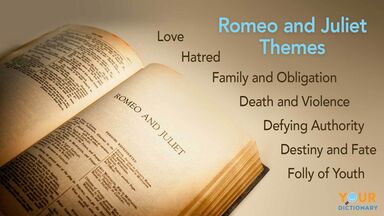 examples of themes in romeo and juliet
The Power of Love
At its core, Shakespeare'southward famous tragedy is a story well-nigh the all-consuming power of love. In that location are several beloved themes in Romeo and Juliet, simply the strongest is how powerful dearest can be. We offset see its depths when Romeo laments being out of favor of Rosaline, his starting time dearest:
"ROMEO
Why such is love's transgression.
Griefs of mine ain lie heavy in my breast,
Which thou wilt propagate to have it prest
With more of thine. This beloved that thou hast shown
Doth add together more grief to too much of mine ain.
Love is a smoke made with the fume of sighs;
Being purg'd, a fire sparkling in lovers' eyes;
Being vex'd, a bounding main nourish'd with lovers' tears:
What is it else? A madness most unimposing,
A choking gall, and a preserving sweet."
- Act 1, Scene 1
Romeo'south love for Rosaline, and his heartbreak at her disaffection, affects everything he says or thinks. The just strength stiff plenty to break him of this spell is his newfound love for Juliet, which occurs at full force for Romeo upon seeing her:
"ROMEO
O, she doth teach the torches to burn bright!
It seems she hangs upon the cheek of night
As a rich jewel in an Ethiop's ear;
Dazzler also rich for apply, for world also dear!
So shows a snowy dove trooping with crows
As yonder lady o'er her fellows shows.
The measure washed, I'll sentinel her place of stand,
And touching hers, make blessed my rude hand.
Did my heart love till now? Forswear it, sight!
For I ne'er saw true beauty till this night."
- Deed 1, Scene 5
The love between Romeo and Juliet drives the plot forward, as nigh every decision they brand is in service of their love for each other. 1 such decision is their choice to marry each other the day after coming together:
"ROMEO
Ah, Juliet, if the measure of thy joy
Be heap'd like mine, and that thy skill be more
To blazon information technology, then sweeten with thy breath
This neighbour air, and let rich music'southward tongue
Unfold the imagin'd happiness that both
Receive in either past this dear encounter.JULIET
Conceit more rich in matter than in words,
Brags of his substance, not of ornament.
They are but beggars that can count their worth;
But my true dearest is grown to such backlog,
I cannot sum upward sum of half my wealth."
- Human action 2, Scene 6
Romeo's determination to finish the duel between Mercutio and Tybalt is another instance of his dear for Juliet. But when Tybalt kills Mercutio anyway, Romeo's love for his friend blinds him — just as his beloved for both Rosaline and Juliet blinded him before — and he kills Tybalt in an act of rage. The literary theme of honey is responsible for both the happiness and the tragedy in the play.
The Power of Hatred
Nothing is more powerful than honey in Romeo and Juliet — except, at times, the power of detest. The source of this hatred is never revealed to the reader, merely it's potent plenty to attach each name to bitter resentment. For instance, When Juliet meets Romeo, she is blinded by love until she finds out that he is a Montague.
"JULIET
My only beloved sprung from my just hate!
Too early seen unknown, and known likewise late!
Biggy nativity of beloved information technology is to me,
That I must honey a loathed enemy."
- Deed 1, Scene five
The pair spend the unabridged play pursuing their love and avoiding the hatred between their families. Just ultimately, that hatred combined with Romeo and Juliet's beloved leads to their untimely deaths, equally the prince declares:
"PRINCE
This letter doth make practiced the Friar's words,
Their course of honey, the tidings of her death.
And here he writes that he did buy a poison
Of a poor 'pothecary, and therewithal
Came to this vault to dice, and lie with Juliet.
Where be these enemies? Capulet, Montague,
See what a scourge is laid upon your hate,
That heaven finds means to impale your joys with love!
And I, for winking at your discords likewise,
Have lost a brace of kinsmen. All are punish'd."
- Act 5, Scene iii
The culmination of the hatred between the Capulets and Montagues is too poetic and tragic to bear, as "heaven finds ways to kill your joys with love." The families swear to "a glooming peace" and pay tribute to each other's losses. They are forced to honey each other due to the wretchedness of their hatred.
Family and Obligation
Many of the tragic events in Romeo and Juliet come from the characters' desire to serve their families, creating a theme of family and obligation. When Romeo and Juliet meet, the noesis that they are in opposing families is plenty to threaten the hereafter of their relationship. Juliet talks to herself about this tragedy, and wishes that she could trade his proper noun for their beloved:
"JULIET
'Tis only thy proper noun that is my enemy;
Thou fine art thyself, though not a Montague.
What's Montague? It is nor hand nor foot,
Nor arm, nor face, nor any other part
Belonging to a human being. O exist some other name.
What's in a proper name? That which we telephone call a rose
By any other proper noun would scent as sweet;
So Romeo would, were he not Romeo phone call'd,
Retain that love perfection which he owes
Without that title. Romeo, doff thy name,
And for thy proper name, which is no part of thee,
Take all myself."
- Act 2, Scene two
Even so, Juliet's loyalty to her family tests her dearest for Romeo. After they ally and Romeo kills Tybalt, Juliet is and so overcome with grief for her cousin that she lashes out at Romeo:
"JULIET
O serpent centre, hid with a flowering face!
Did always dragon go on so off-white a cave?
Cute tyrant, fiend angelical,
Dove-feather'd raven, wolvish-ravening lamb!
Despised substance of divinest show!
Just opposite to what thou justly seem'st,
A damned saint, an honourable villain!
O nature, what hadst thou to do in hell
When one thousand didst bower the spirit of a fiend
In mortal paradise of such sugariness flesh?
Was ever book containing such vile affair
So fairly bound? O, that deceit should dwell
In such a gorgeous palace."
- Deed 3, Scene two
For just a moment, Juliet's obligation remains to her family, rather than with Romeo, who is now her husband. But soon she comes to her senses and again chooses Romeo over her grief for Tybalt.
Defying Authority
Romeo and Juliet defy the rivalry of their parents, simply they aren't the but characters who contribute to the theme of defying authority. Both the Montague and Capulet families are a part of Verona society, and at that place is no love lost between them and Prince Escalus who desperately tries to keep lodge in his town.
"PRINCE
... Iii civil brawls, bred of an blusterous discussion,
By thee, former Capulet, and Montague,
Have thrice disturb'd the tranquility of our streets,
And fabricated Verona's ancient citizens
Cast by their grave beseeming ornaments,
To wield old partisans, in easily as old,
Canker'd with peace, to part your canker'd hate.
If ever yous disturb our streets again,
Your lives shall pay the forfeit of the peace.
For this time all the rest depart abroad:
You lot, Capulet, shall go along with me,
And Montague, come up you this afternoon,
To know our farther pleasure in this case,
To former Gratuitous-town, our common judgement-place.
Once again, on hurting of death, all men depart."
- Deed 1, Scene ane
Throughout the play, characters constantly defy this authority every bit Romeo and Juliet defy their parents. Juliet draws the anger of her father when she refuses to marry Paris (because she is already married to Romeo):
"CAPULET
Hang thee young baggage, disobedient wretch!
I tell thee what,—get thee to church building a Th,
Or never after expect me in the face up.
Speak not, reply not, do not answer me.
My fingers crawling. Wife, we deficient thought us blest
That God had lent us just this only child;
Simply at present I see this one is ane as well much,
And that we take a curse in having her."
- Human activity 3, Scene 5
Juliet loves her begetter simply must defy him to pursue her life with Romeo. Simply as the Montagues and Capulets ignore the prince'southward commands, she ignores the demands of her parents, and pretends to be dead rather than listen to them.
Violence and Expiry
The theme of violence and expiry is evident from the very beginning scene to the very last scene in the play. Every expiry in Romeo and Juliet comes from a wheel of violence that seems never-catastrophe. The offset character to dice a vehement death is Mercutio, who is killed past Tybalt under Romeo's arm, and avenged past Romeo himself:
"ROMEO
Once more in triumph, and Mercutio slain?
Abroad to heaven respective lenity,
And fire-ey'd fury be my carry now!
Now, Tybalt, accept the 'villain' dorsum again
That late thou gav'st me, for Mercutio'due south soul
Is but a trivial mode above our heads,
Staying for thine to go on him company.
Either yard or I, or both, must become with him."
Tybalt then dies, and Romeo is banished. Lady Montague dies of a broken heart upon hearing the news of his banishment. Juliet works with Friar Lawrence to pose as dead and see Romeo in the Capulet tomb. However, Romeo doesn't go the bulletin, and kills both Paris and himself as a result.
"ROMEO
... How oftentimes when men are at the point of death
Take they been merry! Which their keepers call
A lightning earlier expiry. O, how may I
Call this a lightning? O my love, my wife,
Expiry that hath suck'd the honey of thy breath,
Hath had no power nevertheless upon thy beauty.
Thou art non conquer'd. Dazzler's ensign yet
Is blood-red in thy lips and in thy cheeks,
And death's pale flag is not avant-garde there.
Tybalt, liest g there in thy encarmine sail?
O, what more favour tin can I do to thee
Than with that manus that cut thy youth in twain
To sunder his that was thine enemy ..."
Romeo effectively ends the bike of violence and revenge with his own death; he has killed the killer of Tybalt. Juliet takes her own life upon seeing Romeo dead, making hers the final toll of the constant grudge betwixt the families.
The Folly of Youth
Romeo and Juliet are among the youngest characters in the play, and they deed with the impulsivity of youth, which leads to folly. They are non the only characters to practise and so, as hotheaded Capulets and Montagues regularly brawl in the streets. Simply equally Friar Lawrence warns, acting in haste can atomic number 82 to overwhelming regret.
"FRIAR LAWRENCE
These violent delights have tearing ends,
And in their triumph die; like fire and pulverisation,
Which as they osculation eat.The sweetest honey
Is loathsome in his own deliciousness,
And in the sense of taste confounds the appetite.
Therefore love moderately: long love doth so;
Too swift arrives every bit tardy as too slow."
- Act 2, Scene 6
The friar'due south foresight comes into play in the very next scene, where Romeo is overtaken by revenge and kills Tybalt. He afterwards acknowledges the role his youth has played in his current situation.
"ROMEO
Thou canst non speak of that yard dost not feel.
Wert k equally young as I, Juliet thy love,
An hour but married, Tybalt murdered,
Doting like me, and like me banished,
Then mightst 1000 speak, then mightst thou tear thy hair,
And fall upon the ground as I do now,
Taking the mensurate of an unmade grave."
- Act 3, Scene three
Romeo's tears and misery over being banished, like Juliet's hysterics over the possibility of marrying Paris, contrast sharply with the politically minded adults in the room. Their youthful emotions conduct them through dear, marriage, and ultimately, their demise.
Destiny and Fate
Like any tragedy, the principal characters' fate is already decided by their fatal flaws and circumstances. The truly tragic moments of Romeo and Juliet occur when their fate seems avoidable — had Romeo successfully intervened in the duel between Tybalt and Mercutio, or had Friar's Lawrence'due south letter of the alphabet reached him in time, perhaps Romeo and Juliet would take survived. But as the original "star-cross'd lovers," their destiny was already decided.
Romeo'due south deep love and impulsiveness — his fatal flaw — brings him to avenge Mercutio and lament his own part in his fate.
"BENVOLIO
Romeo, away, be gone!
The citizens are upwardly, and Tybalt slain.
Stand not amaz'd. The Prince will doom thee expiry
If thou fine art taken. Hence, be gone, away!ROMEO
O, I am fortune'due south fool!"
After, when Romeo is leaving Juliet for the concluding fourth dimension, they discuss their future. Juliet has a premonition of the future:
"JULIET
O thinkest grand we shall e'er run across over again?ROMEO
I doubt information technology not, and all these woes shall serve
For sweet discourses in our time to come.JULIET
O God! I accept an ill-divining soul!
Methinks I encounter thee, now m art so low,
Every bit ane expressionless in the bottom of a tomb.
Either my eyesight fails, or m wait'st pale.ROMEO
And trust me, love, in my eye so practice you.
Dry sorrow drinks our blood. Cheerio, adieu."
Juliet's vision of Romeo in a tomb comes true in the last scene of the play, where he drinks toxicant to join her in death. The tragic events that have already unfolded to this signal make up one's mind their future together.
Never Was a Story of More Woe
The literary themes throughout Romeo and Juliet have made the story an enduring tragedy for generations of audiences. Death, life, love, hatred, obligation, and destiny all play a manus in the play's famous ending. Take a look at the soliloquies in Romeo and Juliet and how they reveal the characters' motives. Or, for a more in-depth look at the linguistic communication of the tragedy, check out these examples of oxymorons in Romeo and Juliet.
Source: https://reference.yourdictionary.com/books-literature/7-main-themes-romeo-juliet-simplified
0 Response to "O Thou That Art Conducted Through This Hell Simplification"
Post a Comment