Mutable Variable Calling Original Chart Again D3
Introduction
D3 (https://d3js.org) stands for Data-Driven Documents. It is a JavaScript library that renders, and re-renders, HTML elements (including svg) in a web browser based on data and changes to the data.
D3 is primarily used for data visualizations such as bar charts, pie charts, line charts, scatter plots, geographic maps, and more. But equally you will see, it has quite a fleck of overlap with jQuery and can be used for many kinds of DOM manipulations that are not related to data visualization.
So why should I write nigh D3 at present? Afterward all, it has been around since Feb 2011. Many tutorial articles already exist. But many of those describe older versions of D3, and each major version included breaking changes. Version 5 of D3 was released in January, 2018. And then this is my take chances to write an up-to-engagement D3 tutorial and effort to get in like shooting fish in a barrel to understand. Of course, yous will exist the estimate of whether I am successful.
JavaScript has been my master programming language for the entirety of the life of D3. I have known of the existence of D3 for quite a while only have ignored it considering I was more focused on other JavaScript-based topics, including jQuery, Angular, React, Vue, Graceful, and TypeScript. It was fourth dimension for me to stop ignoring D3 and dig in.
D3 was created past Mike Bostock, along with other contributors. It is open source and uses a BSD license.
D3 uses HTML, CSS, JavaScript, the DOM, and SVG, and then knowledge of those topics is helpful.
At that place are iii levels of D3 usage:
- Using college-level libraries. An example of a library that uses D3 is C3 (https://c3js.org/). C3 uses D3 nether the hood to render many kinds of charts. These charts are customizable, but not to the extent that can be achieved when coding from scratch. However, charts can exist implemented apace using C3, and the requirement to have deep cognition of D3 is removed. C3 charts respond well to changes in data by default, including transitions from old to new values.
- Copying and modifying D3 examples. At that place are many sites that provide examples of charts implemented with D3. Perhaps you can discover an example that renders most exactly what you want. Copying and customizing the code will often crave far less time than implementing a nautical chart from scratch.
- Coding from scratch. My hope is that past the time you cease reading this article, you will know enough virtually D3 to enable the final option, which is implementing an entire chart from scratch. This provides the most flexibility but requires the virtually endeavour.
The D3 JavaScript API uses CSS selectors to observe elements in the DOM that information technology modifies. It likewise provides methods to suspend elements and text nodes, gear up attributes, and modify text content. In this respect it has overlap with jQuery functionality.
The functionality of D3 is divided into modules. The default build of D3 includes all of the modules. Custom builds tin omit unneeded modules in order to minimize the amount of code that must be downloaded to browsers.
The D3 modules include:
- Arrays
- Axes
- Brushes
- Chords
- Collections (Objects, Maps, Sets, Nests)
- Colors
- Color Schemes
- Contours
- Dispatches
- Dragging
- Delimiter-separated Values
- Easings
- Fetches
- Forces
- Number Formats
- Geographies
- Hierarchies
- Interpolators
- Paths
- Polygons
- Quadtrees
- Random Numbers
- Scales
- Selections
- Shapes
- Time Formats
- Fourth dimension Intervals
- Timers
- Transitions
- Voronoi Diagrams
- Zooming
Let's larn D3 by example.
Many D3 tutorials start with a bar chart and and so will this one. Just ours will include more than features than are typically shown in tutorials in club to innovate more than D3 concepts.
You are encouraged to copy the code in the article and try it in a web browser!
SVG Basics
SVG stands for Scalable Vector Graphics. It is an XML-based syntax for specifying vector graphics. SVG is supported past all mod web browsers, even dorsum to IE9.
SVG elements include svg, line, polygon, rect, circle, path, text, paradigm, g (for grouping), and many more than. For our bar chart will will only demand svg, g, rect, and text.
Let's first by drawing a rectangle and placing text on it as shown below.
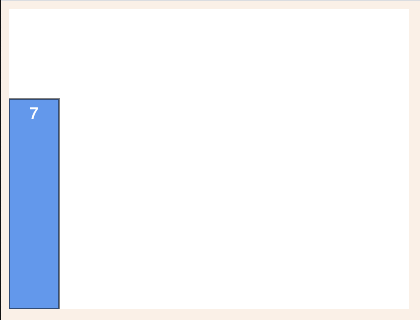
We will implement this with divide HTML, CSS, and JavaScript files, but all of this could be combined into 1 HTML file if that'south your style.
svg-demo.html
This HTML includes all the bells and whistles to give a practiced Lighthouse score, including a DOCTYPE, language specification, and meta tags. To learn about Lighthouse, see https://developers.google.com/web/tools/lighthouse.
-
<!DOCTYPE html>
-
<html lang = "en">
-
<head>
-
<title>D3 SVG Demo</ championship>
-
<meta charset = "utf-eight" />
-
<meta name = "clarification" content = "D3 SVG Demo" />
-
<meta name = "viewport" content = "width=device-width, initial-calibration=1" />
-
<link rel = "stylesheet" href = "./svg-demo.css" />
-
<script src = "https://d3js.org/d3.v5.min.js"></ script>
-
<script src = "./svg-demo.js" defer></ script>
-
</ caput>
-
<body>
-
<svg id = "chart"></svg>
-
</ body>
-
</ html>
svg-demo.css
-
trunk {
-
background-color : linen;
-
font-family : sans-serif ;
-
}
-
.bar > rect {
-
stroke: blackness ;
-
stroke-width: i ;
-
}
-
.bar > text {
-
make full: white ;
-
text-anchor: centre ; /* horizontally centers */
-
}
-
#chart {
-
background-color : white ;
-
}
svg-demo.js
-
const Pinnacle = 300 ;
-
const WIDTH = 400 ;
-
const score = 7 ; // out of 10
-
const barHeight = HEIGHT * (score / 10 ) ;
-
const barWidth = 50 ;
-
// Find the DOM element with an id of "nautical chart" and set up its width and elevation.
-
// This happens to be an svg element.
-
const svg = d3.select ( '#chart' ).attr ( 'width' , WIDTH).attr ( 'height' , Acme) ;
-
// Append a group chemical element to the svg and add a CSS class of "bar".
-
const group = svg.suspend ( '1000' ).attr ( 'course' , 'bar' ) ;
-
// Suspend a rect element to the group and set its properties.
-
// The background color of an SVG element is set using the "fill" property.
-
grouping
-
.suspend ( 'rect' )
-
.attr ( 'elevation' , barHeight)
-
.attr ( 'width' , barWidth)
-
.attr ( 'x' , 0 )
-
.attr ( 'y' , Superlative - barHeight)
-
.attr ( 'fill' , 'cornflowerblue' ) ;
-
// Append a text element to the group and set up its properties.
-
group
-
.append ( 'text' )
-
.text (score)
-
.attr ( 'x' , barWidth / two ) // center horizontally in bar
-
.attr ( 'y' , HEIGHT - barHeight + 20 ) ; // but beneath peak
That'southward the very nuts of working with SVG. Simply information technology's all you need to know to draw additional bars in a bar chart later on.
D3 Selection Objects
A D3 selection object encapsulates a set of DOM elements, similar to a jQuery object. To create one, use the d3 methods select and selectAll.
For example, d3.select('.bar') returns a selection object that encapsulates the first element in the DOM with a CSS class of "bar". d3.selectAll('.bar') is similar, but the returned selection object encapsulates all matching DOM elements.
The select and selectAll methods can as well be chosen on a selection to discover elements that are descendants of the elements in the pick within the DOM tree.
Here is an example that demonstrates using the select and selectAll methods.
-
<html>
-
<head>
-
<title>D3 Selections</ championship>
-
<script src = "https://d3js.org/d3.v5.min.js"></ script>
-
</ head>
-
<body>
-
<div class = "chart" id = "chart1">
-
<div class = "bar">Bar #1</ div>
-
<div form = "bar">Bar #2</ div>
-
<div class = "bar">Bar #3</ div>
-
</ div>
-
<div course = "chart" id = "chart2">
-
<div grade = "bar">Bar #4</ div>
-
<div class = "bar">Bar #5</ div>
-
</ div>
-
<script>
-
// Select all elements with a CSS class of "bar".
-
const bars1 = d3.selectAll('.bar');
-
console.log('bars1 =', bars1);
-
// Select all elements with a CSS course of "bar" that are
-
// descendants of the element with an id of "chart1".
-
const chart1 = d3.select('#chart1');
-
const bars2 = chart1.selectAll('.bar');
-
panel.log('bars2 =', bars2);
-
// Select all elements with a CSS class of "bar" that are
-
// descendants of whatever chemical element with a CSS class of "chart".
-
const charts = d3.selectAll('.chart');
-
const bars3 = charts.selectAll('.bar');
-
console.log('bars3 =', bars3);
-
</ script>
-
</ body>
-
</ html>
Here is the output from the console.log calls found in the browser DevTools console.
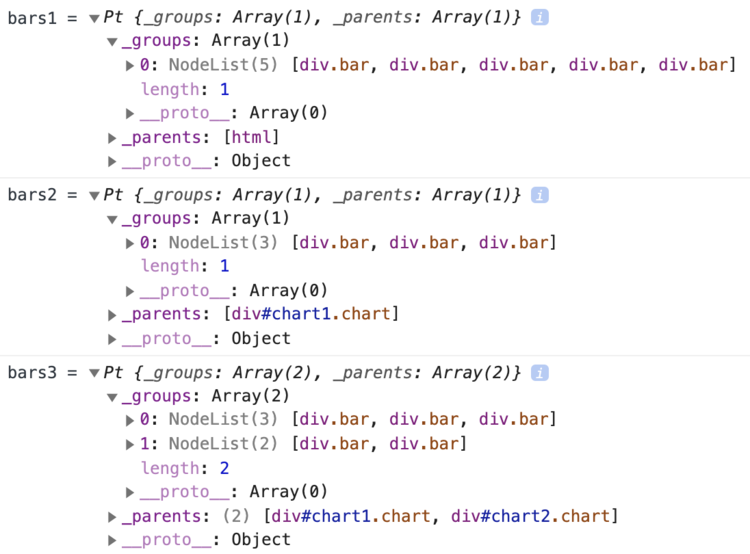
Each pick object has the following properties:
-
_parents - This is an array of the DOM elements that were searched. When the
selectandselectAllmethods are called on thed3object, this array will contain only thehtmlelement of the current document. When these methods are called on an existing option, this assortment will contain all the DOM elements in that selection. -
_groups - This is an array of DOM
NodeListobjects, one per chemical element in_parents. TheseNodeListobjects contain the matching DOM elements.
In the bars1 selection:
-
_parentscontains merely thehtmlelement, indicating that the entire document was searched. -
_groupsholds a singleNodeListthat contains every DOM element with a CSS class of "bar."
In the bars2 selection:
-
_parentscontains only the element with an id of "chart1." This happens because the search was performed on a selection that contains simply that element. -
_groupsholds a singleNodeListthat contains only the DOM elements with a CSS class of "bar" that are descendants of the chemical element with an id of "chart1."
In the bars3 choice:
-
_parentscontains the ii elements with a CSS class of "chart" considering the search was performed on a pick that contains just these elements. -
_groupsholds twoNodeListobjects, one for each parent chemical element. Each of these contains the DOM elements with a CSS class of "bar" that are descendants of their respective parent elements.
The data method
Pick objects have a data method that associates information in an array with the DOM elements in the option. It does this by calculation a __data__ belongings to them.
Here is an instance that demonstrates calling the data method on a pick.
-
<html>
-
<head>
-
<title>D3 data method</ championship>
-
<script src = "https://d3js.org/d3.v5.min.js"></ script>
-
</ caput>
-
<trunk>
-
<script>
-
const values = [7, xiii, 2];
-
const bars = d3.selectAll('.bar').data(values);
-
panel.log('confined =', bars);
-
</ script>
-
</ body>
-
</ html>
Here is the output from the console.log telephone call found in the browser DevTools console.
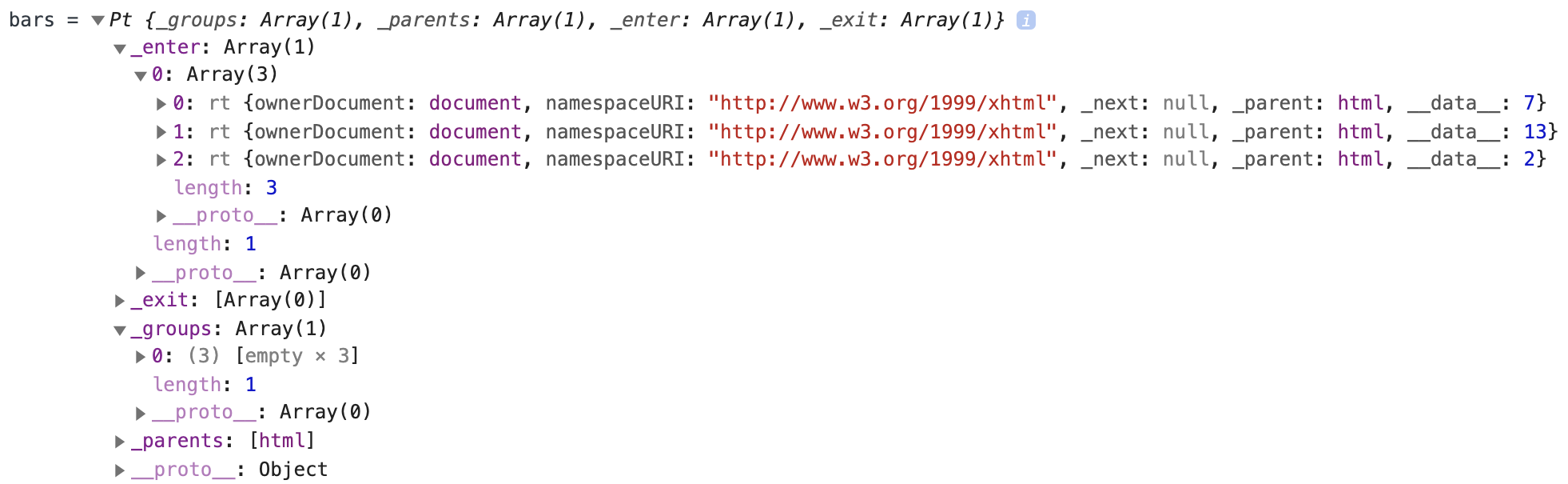
If the values in the array passed to the data method are objects, a second argument which is a function can be passed. This is responsible for extracting or computing a value from each object in the assortment.
For instance, suppose you take an assortment in a variable named paintings that contains objects that describe paintings and they have the properties paintingName, width, and top. Yous tin can use the surface area of each painting as the values every bit follows:
someSelection.data (paintings, p => p.width * p.height ) ; The information method returns a new selection that contains three sub-selections referred to as "update," "enter," and "exit."
The update sub-selection is held in the _groups holding and contains all the DOM elements in the option that can be updated with a information value.
The enter sub-selection is held in the _enter holding and contains a placeholder for each DOM element that must be created in order to associate a information value. These elements volition enter the DOM. Note the __data__ belongings values in each of these placeholder objects.
The exit sub-choice is held in the _exit property and contains all the DOM elements in the selection for which no data volition be assigned. Typically these elements exit the DOM past being removed.
There are iii scenarios to consider.
- There are no DOM elements in the selection.
- There are DOM elements in the selection but fewer than the number of information values.
- There are DOM elements in the option merely more than the number of information values.
Y'all have already seen the starting time scenario in the previous code example where there were 3 data values and no elements with a CSS course of "bar."
To see the 2d scenario, add the following to that HTML.
<div class = "bar"></ div> <div class = "bar"></ div> Reloading the page in the browser, y'all will run across that the update sub-selection holds these two elements with the values seven and xiii. The enter sub-selection now contains a unmarried placeholder with the value 2. The get out sub-option is empty.
To run into the third scenario, add 3 more div elements with a course of "bar," then at that place are a full of v. Reloading the folio in the browser, yous will see that the update sub-selection holds three elements with the values 7, thirteen, and 2. The enter sub-selection is empty. The exit sub-choice holds ii elements that tin be removed.
In order to support irresolute data, both values and the number of values, you demand to handle all three sub-selections. This ways you demand a way to iterate over the elements in each.
To iterate over all the elements in the update sub-option, call methods such as text directly on the pick object.
To process the enter sub-selection, obtain a new selection by calling the enter method, then telephone call methods on that selection.
To process the exit sub-pick, obtain a new option by calling the leave method, and then call methods on that selection.
The post-obit example demonstrates each of these. Information technology generates an array containing a random number of random integers. These are used to brandish values in div elements that have a CSS class of "bar." Their text indicates whether the element was updated or just entered the DOM. Each time the "Update" push is pressed, the procedure repeats, and previously created div elements are reused.
Selection objects support many methods, some of which act on all the DOM elements they encapsulate. They practice this past iterating over the elements in the NodeList values found in their _groups assortment. Examples include the attr, style, and text methods, 2 of which are used beneath.
These methods have a function that is invoked once for each encapsulated DOM element. The function is passed the value of the __data__ property value and the index of the DOM element within the selection. Inside these functions, the current element can exist accessed using the this keyword. In order to use this, the function must not be an arrow function.
Just like in jQuery, it is not an mistake to telephone call such a method on a selection that is empty, meaning it doesn't encapsulate whatever DOM elements.
Selection objects are immutable, pregnant the set of DOM elements they encapsulate cannot be changed. However, at that place are many methods on choice objects that return a new selection, including filter, merge, select, and selectAll.
This example demonstrates processing the sub-selections in a selection. Information technology simply renders div elements that indicate whether they were just added to the DOM or they already existed and merely had their text updated. Annotation that SVG is non used in this example.
-
<html>
-
<head>
-
<title>D3 information method</title>
-
<script src= "https://d3js.org/d3.v5.min.js" ></script>
-
</head>
-
<torso>
-
<button onclick= "update()" >Update</button>
-
<div id= "chart" ></div>
-
<script>
-
// Gets a random integer between one and max inclusive.
-
const randomInt = max => Math.floor ( Math.random ( ) * max) + 1 ;
-
// Generates an assortment containing a random number of random integers.
-
office getValues( ) {
-
const count = randomInt( 7 ) ;
-
const values = [ ] ;
-
for (let i = 0 ; i < count; i++ ) {
-
values.push (randomInt( 10 ) ) ;
-
}
-
render values;
-
}
-
function update( ) {
-
const values = getValues( ) ;
-
console.log ( 'values =' , values) ;
-
// Create a D3 selection representing the confined
-
// which are div elements with a CSS class of "bar",
-
// and associate data values with them.
-
const bars = d3.select ( '#chart' ).selectAll ( '.bar' ).data (values) ;
-
// Update the text of bar elements that are already in the DOM.
-
bars.text (d => 'update ' + d) ;
-
// Create new bar elements that need to enter the DOM
-
// and set their text.
-
bars
-
.enter ( )
-
.append ( 'div' )
-
.attr ( 'class' , 'bar' )
-
.text (d => 'enter ' + d) ;
-
// Remove bar elements that demand to go out the DOM.
-
bars.go out ( ).remove ( ) ;
-
}
-
update( ) ; // initial call
-
</script>
-
</trunk>
-
</html>
This is a mutual D3 pattern referred to as the "general update pattern." It can be simplified in a couple of means.
The first simplification is to apply the merge method. This is called subsequently appending elements to the enter sub-pick. Information technology creates a new selection by combining elements in the selection on which information technology is called (the enter sub-selection in this instance) with the selection passed to information technology (the update sub-selection in this case). The phone call that follows this operates on the new selection. This approach allows usa to supplant the "Update" and "Create" sections to a higher place with the following:
bars .enter ( ) // returns the enter sub-choice .append ( 'div' ) // returns the enter sub-selection .attr ( 'class' , 'bar' ) // returns the enter sub-selection .merge (bars) // returns a new selection .text (d => 'value ' + d) ; We accept lost the ability to specify dissimilar text for updated and entered elements, but that is not typically needed.
THE join METHOD
A 2nd simplification that tin can be made to the code higher up is to use the bring together method. This takes upwards to iii functions, one to handle each sub-selection. They must exist in the social club enter, update, and exit.
Using this approach, the lawmaking above, including the lawmaking for handling the get out sub-selection, can be replaced by the following.
bars.join ( enter => enter .suspend ( 'div' ) .attr ( 'form' , 'bar' ) .text (d => 'enter ' + d) , update => update.text (d => 'update ' + d) , // This is the default beliefs for the leave sub-selection // and can be omitted. go out => exit.remove ( ) ) ; This regains the ability to have different text for updated and entered elements. Merely if that is not needed, y'all tin can shorten the code even more by passing the name of the element to exist created to the join method as follows. This handles:
- The enter sub-selection by creating new
divelements with a class of "bar" - Both the enter and update sub-selections by setting the text of those elements
- The exit sub-selection by removing those elements from the DOM
bars .join ( 'div' ) .attr ( 'course' , 'bar' ) .text (d => 'value ' + d) ; If you're feeling somewhat comfortable at present with the notion of option objects, their three sub-selections, and the full general update pattern, you are set up to put that knowledge to use for creating your first chart.
Drawing Bars
Earlier you learned how to draw a single bar. Permit'due south combine that with what yous accept learned most selections to draw one bar for each piece of data in an array.
We will create a bar nautical chart like the following:
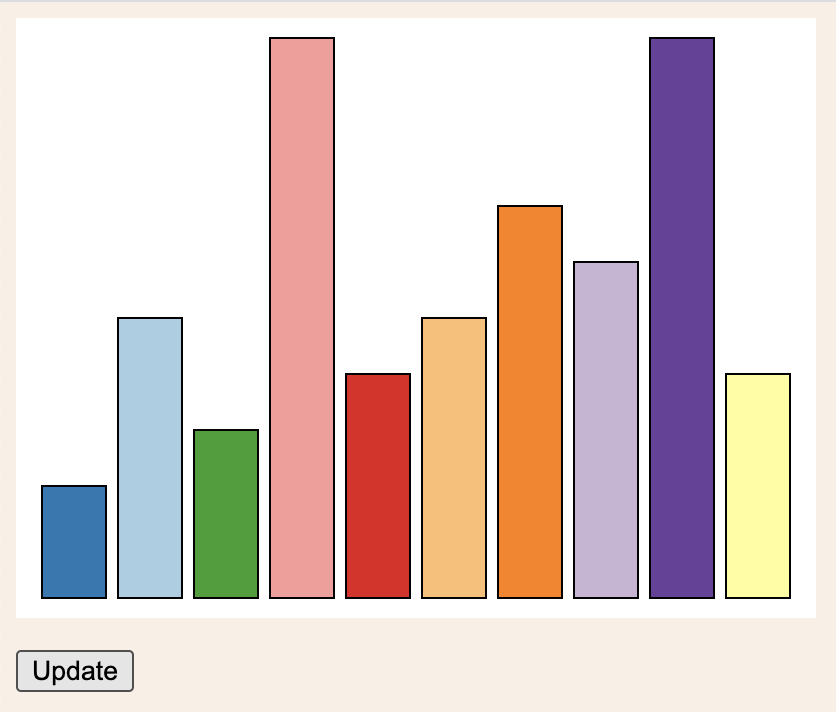
The "Update" button generates new, random data and updates the bars. This is implemented by the files alphabetize.html, bar-chart.css, and bar-chart.js which are shown below.
This code gives us a adept base for adding features. There are many D3 concepts to cover here. Run across the comments in the code for details.
index.html
-
<html>
-
<caput>
-
<championship>D3 Bar Chart</ title>
-
<meta charset = "utf-8" />
-
<meta proper noun = "clarification" content = "D3 Bar Chart" />
-
<meta proper name = "viewport" content = "width=device-width, initial-scale=i" />
-
<link rel = "stylesheet" href = "./bar-chart.css" />
-
<script src = "https://d3js.org/d3.v5.min.js"></ script>
-
<script src = "./bar-chart.js" defer></ script>
-
</ head>
-
<body>
-
<!-- The confined volition be added in this svg chemical element. -->
-
<svg id = "chart"></svg>
-
<div>
-
<!-- Render a new version of the chart when this is pressed. -->
-
<push onclick = "updateData()">Update</ button>
-
</ div>
-
</ body>
-
</ html>
bar-nautical chart.css
-
trunk {
-
background-colour : linen;
-
font-family : sans-serif ;
-
}
-
.bar > rect {
-
stroke: black ;
-
stroke-width: i ;
-
}
-
button {
-
margin-top : 1rem;
-
}
-
#nautical chart {
-
background-color : white ;
-
}
bar-nautical chart.js
-
// Later these will exist adjusted to make room
-
// for a vertical and horizontal centrality.
-
const BOTTOM_PADDING = x ;
-
const LEFT_PADDING = 10 ;
-
const RIGHT_PADDING = 10 ;
-
const TOP_PADDING = 10 ;
-
// Full size of the svg chemical element.
-
const HEIGHT = 300 ;
-
const WIDTH = 400 ;
-
// Size that tin can exist used for the confined.
-
const usableHeight = HEIGHT - TOP_PADDING - BOTTOM_PADDING;
-
const usableWidth = WIDTH - LEFT_PADDING - RIGHT_PADDING;
-
// Random data will be selected from this assortment.
-
const allData = [
-
{name: 'apple' , colorIndex: one } ,
-
{proper noun: 'banana' , colorIndex: 2 } ,
-
{name: 'cherry' , colorIndex: 3 } ,
-
{name: 'engagement' , colorIndex: 4 } ,
-
{name: 'grape' , colorIndex: 5 } ,
-
{proper name: 'mango' , colorIndex: 6 } ,
-
{name: 'peach' , colorIndex: vii } ,
-
{name: 'raspberry' , colorIndex: eight } ,
-
{proper noun: 'strawberry' , colorIndex: 9 } ,
-
{name: 'tangerine' , colorIndex: x } ,
-
{name: 'watermelon' , colorIndex: 11 }
-
] ;
-
let barPadding, barWidth, xScale, yScale;
-
// This is used to select bar colors based on their colorIndex.
-
const colorScale = d3.scaleOrdinal (d3.schemePaired ) ; // 12 colors
-
// This returns a random integer from ane to max inclusive.
-
const random = max => Math.floor ( Math.random ( ) * max + i ) ;
-
// This returns an array of objects taken from allData.
-
// A "score" belongings with a random value from 1 to 10
-
// is added to each object.
-
function getRandomData( ) {
-
const count = random(allData.length ) ;
-
const shuffled = allData.sort ( ( ) => 0.5 - Math.random ( ) ) ;
-
const data = shuffled.slice ( 0 , count) ;
-
data.sort ( (f1, f2) => f1.proper name.localeCompare (f2.name ) ) ;
-
for ( const item of data) {
-
detail.score = random( ten ) ;
-
}
-
return data;
-
}
-
// This updates the attributes of an SVG rect element
-
// that represents a bar.
-
role updateRect(rect) {
-
rect
-
// Each fruit will keep the aforementioned color as its score changes.
-
.attr ( 'fill' , d => colorScale(d.colorIndex ) )
-
.attr ( 'width' , barWidth - barPadding * two )
-
.attr ( 'height' , d => usableHeight - yScale(d.score ) )
-
.attr ( 'x' , barPadding)
-
.attr ( 'y' , d => TOP_PADDING + yScale(d.score ) ) ;
-
}
-
// This updates the bar chart with random data.
-
function updateData( ) {
-
const data = getRandomData( ) ;
-
// Calculate padding on sides of confined based on # of confined.
-
barPadding = Math.ceil ( thirty / data.length ) ;
-
// Calculate the width of each bar based on # of bars.
-
barWidth = usableWidth / data.length ;
-
// Create a scale to map data index values to x coordinates.
-
// This is a function that takes a value in the "domain"
-
// and returns a value in the "range".
-
xScale = d3
-
.scaleLinear ( )
-
.domain ( [ 0 , information.length ] )
-
.range ( [LEFT_PADDING, LEFT_PADDING + usableWidth] ) ;
-
// Create a scale to map data score values to y coordinates.
-
// The range is flipped to account for
-
// the SVG origin being in the upper left corner.
-
// Like xScale, this is a function that takes a value in the "domain"
-
// and returns a value in the "range".
-
// The d3.max function computes the largest data value in a given array
-
// where values are computed by the 2nd argument office.
-
const max = d3.max (data, d => d.score ) ;
-
yScale = d3.scaleLinear ( ).domain ( [ 0 , max] ).range ( [usableHeight, 0 ] ) ;
-
// Create a D3 choice object that represents the svg element
-
// and set the size of the svg element.
-
const svg = d3.select ( '#chart' ).attr ( 'width' , WIDTH).attr ( 'height' , Elevation) ;
-
// This is the virtually critical part to understand!
-
// You learned about about selections and the general update pattern
-
// in the previous department.
-
const groups = svg
-
.selectAll ( '.bar' )
-
.data (data, d => d.proper noun )
-
.bring together (enter => {
-
// Create a new SVG group element for each placeholder
-
// to stand for a new bar.
-
// For now the merely thing in each group will exist a rect element,
-
// but later we will add together a text element to display the value.
-
const groups = enter.suspend ( 'g' ).attr ( 'class' , 'bar' ) ;
-
// Create a new SVG rect element for each group.
-
groups
-
.append ( 'rect' )
-
.attr ( 'height' , 0 )
-
.attr ( 'y' , TOP_PADDING + usableHeight) ;
-
return groups;
-
} ) ;
-
// The join method phone call above returns a selection that combines
-
// the update and enter sub-selections into its update selection.
-
// This allows operations needed on elements in both
-
// to be performed on the new selection.
-
// Translate the groups for each bar to their
-
// appropriate x coordinate based on its index.
-
groups.attr ( 'transform' , (_, i) => `translate(${xScale(i) } , 0 )`) ;
-
// Update all the rect elements using their newly associated data.
-
updateRect(groups.select ( 'rect' ) ) ;
-
}
-
// Render the offset version of the chart.
-
updateData( ) ;
See information technology in action
Calculation a Y Axis
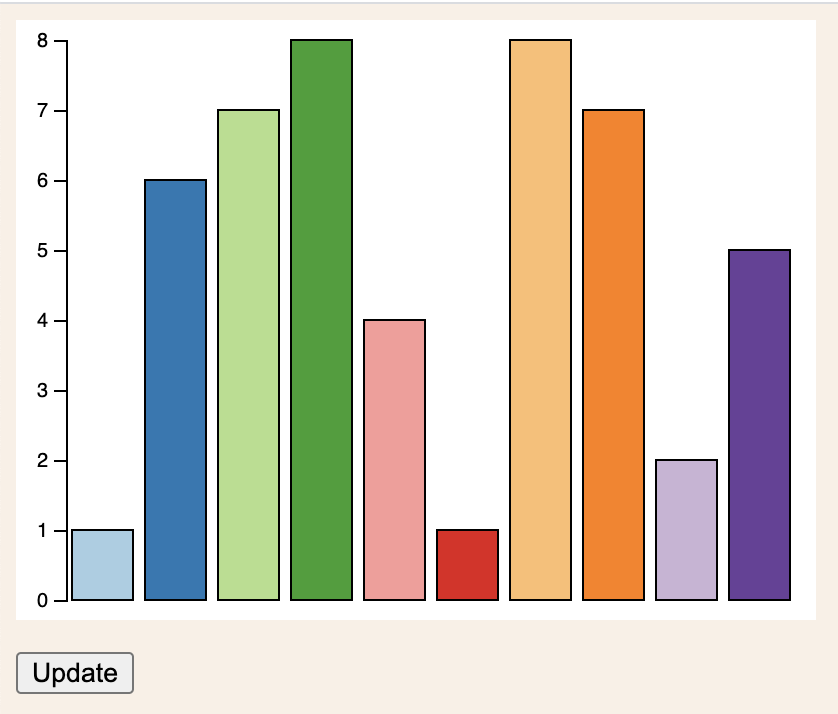
Now let's add together a y centrality to the chart that indicates the bar values. We want this to exist dynamic then that the highest value matches the highest value of whatsoever of the confined that are nowadays.
Here are the steps to add a y axis:
- Increase the value of
LEFT_PADDINGfrom 10 to 25 to leave room for the y centrality. - Add together the variable
yAxisGroupto theletstatement virtually the top every bit follows:
let barPadding, barWidth, xScale, yAxisGroup, yScale; - Add the function
updateYAxisshown below:
function updateYAxis(svg, data, max) { if ( !yAxisGroup) { // Create an SVG group that will hold the y centrality and // translate the group to the appropriate position in the SVG. yAxisGroup = svg .suspend ( 'g' ) .attr ( 'class' , 'y-axis' ) .attr ( 'transform' , `interpret(${LEFT_PADDING} , ${TOP_PADDING} )`) ; } // Create an array with values from zero to max // that will exist used as the tick values on the y axis. const tickValues = Array.from ( Assortment (max + 1 ).keys ( ) ) ; // Create an centrality generator function that renders the yAxis. const yAxis = d3 .axisLeft (yScale) .tickValues (tickValues) .tickFormat (north => n.toFixed ( 0 ) ) ; // Laissez passer the option for the group to the // axis generator function to render information technology. yAxis(yAxisGroup) ; // An equivalent style to exercise this is yAxisGroup.call(yAxis); } - Add the following at the bottom of the
updateDataoffice:
updateYAxis(svg, information, max) ; The result looks similar this:
See it in activity
Adding an X Axis
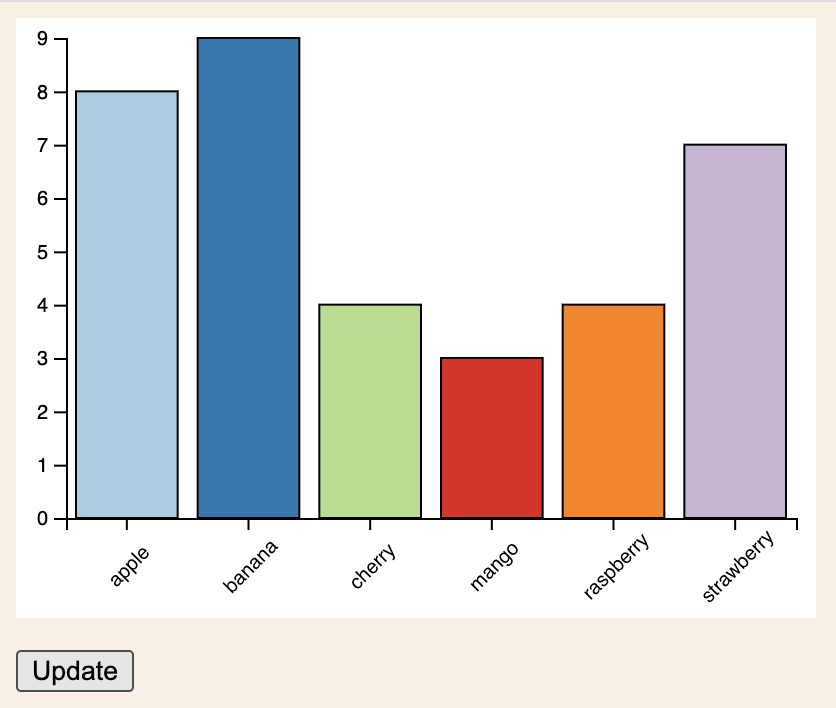
Now let'due south add an ten centrality to the chart featuring values that stand for to the fruit name labels associated with each bar.
In our example the values correspond scores in a poll where respondents proper noun their favorite fruit. Of course all our data is randomly generated.
Here are the steps to add an ten axis:
- Add the following to
bar-chart.cssto position and rotate the x-axis labels:
.x-centrality > .tick > text { /* Interpret and rotate labels so they fit below confined better. */ transform: interpret( -8px , 15px ) rotate(-45deg) ; } - Increase the value of
BOTTOMfrom 10 to fifty to leave room for the x axis. - Add together the variable
xAxisGroupto thepermitstatement near the tiptop every bit follows:
permit barPadding, barWidth, xAxisGroup, xScale, yAxisGroup, yScale; - Add together the function
updateXAxisshown beneath:
role updateXAxis(svg, data) { if ( !xAxisGroup) { // Create an SVG group that volition concur the x axis and // translate the group to the advisable position in the SVG. xAxisGroup = svg .append ( 'g' ) .attr ( 'class' , '10-axis' ) .attr ( 'transform' , `translate( 0 , ${TOP_PADDING + usableHeight} )`) ; } // Create a scale that maps fruit names to positions on the x axis. const xAxisScale = d3 .scaleBand ( ) .domain (information.map (item => item.name ) ) // fruit names .range ( [LEFT_PADDING, LEFT_PADDING + usableWidth] ) ; // Create and call an axis generator office that renders the xAxis. const xAxis = d3.axisBottom (xAxisScale).ticks (data.length ) ; xAxis(xAxisGroup) ; } - Add the following at the lesser of the
updateDatafunction:
The result looks like this:
Run across it in action
Calculation Text on Bars
Now let'south add text to each bar that shows the bar's value. The text should be positioned near the top of each bar and centered horizontally.
The confined have a variety of fill colors. Using white text will wait skilful on some fill colors, simply using black text is amend for others. Nosotros can choose between white and black text by calculating the relative luminance of the bar fill up color. A formula for this can be found in Wikipedia at https://en.wikipedia.org/wiki/Relative_luminance. This is used in the getTextColor function below.
Here are the steps to add text to the bars:
- Add the following CSS rule in
bar-chart.cssto center the text for a bar horizontally within the bar.
.bar > text { text-anchor: middle ; } - Add the post-obit function for choosing the text color to use on a bar with a given fill color.
// This returns a text color to use on a given background color. function getTextColor(bgColor) { // Convert the hex background color to its decimal components. const red = parseInt(bgColor.substring ( 1 , three ) , xvi ) ; const dark-green = parseInt(bgColor.substring ( three , 5 ) , xvi ) ; const blue = parseInt(bgColor.substring ( 5 , 7 ) , sixteen ) ; // Compute the "relative luminance". const luminance = ( 0.2126 * red + 0.7152 * dark-green + 0.0722 * blueish) / 255 ; // Utilise night text on low-cal backgrounds and vice versa. return luminance > 0.5 ? 'black' : 'white' ; } - Add the following function for updating the text for a specific bar:
// This updates the attributes of an SVG text chemical element // that displays the score for a bar. function updateText(text) { text .attr ( 'fill' , d => { const barColor = colorScale(d.colorIndex ) ; return getTextColor(barColor) ; } ) .text (d => d.score ) .attr ( 'x' , barWidth / ii ) // center horizontally in bar .attr ( 'y' , d => TOP_PADDING + yScale(d.score ) + 20 ) ; // only below top } - Add the following inside the
updateDatafunction later on the line that appends arectchemical element to the SVG group for a bar:
// Create a new SVG text element for each group. groups.append ( 'text' ).attr ( 'y' , TOP_PADDING + usableHeight) ; - Add the following after the call to
updateRect:
// Update all the text elements using their newly associated data. updateText(groups.select ( 'text' ) ) ; The result looks like this:
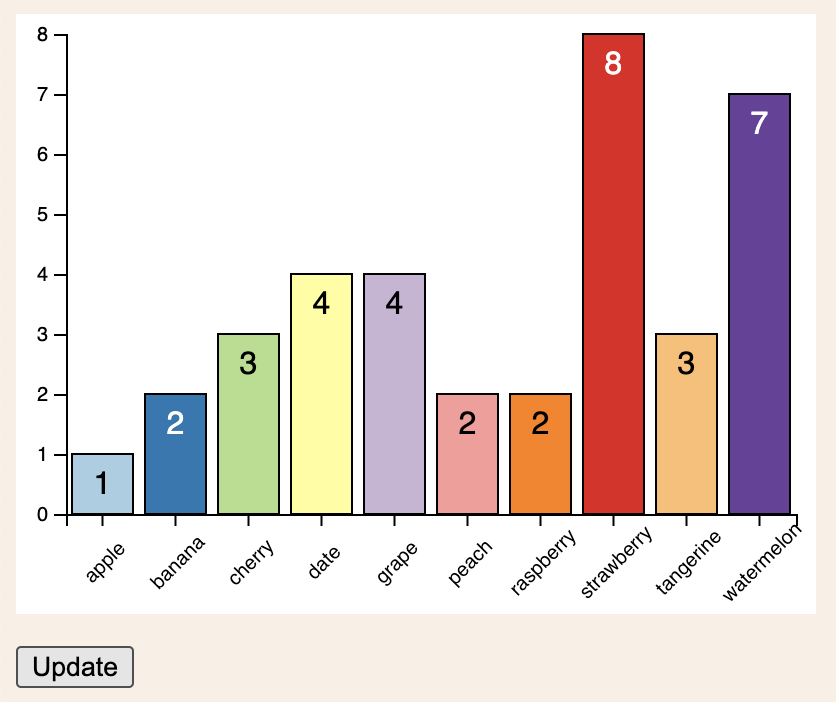
Note how some confined have white text, while others have blackness text.
Encounter it in activeness
Adding Transitions
D3 transitions animate changes to DOM and SVG properties.
Allow's add lawmaking to animate the following:
- changes to the position, width, and elevation of bars
- changes to the position of text on confined
- changes to the x-centrality and y-axis
- removal of confined
Nosotros tin define a transition office that applies a specified transition to any selection. This function can be used to add together all of the transitions listed above. Our transition role will specify but a duration, but it is also possible to specify an amount of time to delay before the transition begins (defaults to zero) and an easing office.
Easing functions control the speed of the transition at diverse times throughout its duration. The easing function defaults to d3.easeCubic when not specified. For descriptions of the provided easing functions and graphs that show their effect, run into https://github.com/d3/d3-ease.
Here are the steps to add together transitions to the bar chart:
- Add the post-obit constant:
const DURATION = 500 ; // of transitions - Add together the following transition part:
// You lot cannot invoke this with the call method on selections // because that volition return the selection // instead of the result of the last telephone call made here. const myTransition = selection => pick.transition ( ).duration (DURATION) ; -
In the
updateRectfunction, supervene upon the offset line, which is justrect, withmyTransition(rect). -
In the
updateTextfunction, replace the starting time line, which is buttext, withmyTransition(text). -
Add the following line at the end of the
updateXAxisrole to create a new selection forxAxisGroupthat has the transition applied:
xAxisGroup = myTransition(xAxisGroup) ; - Add the following line at the finish of the
updateYAxisfunction to create a new selection foryAxisGroupthat has the transition applied:
yAxisGroup = myTransition(yAxisGroup) ; - Currently in the
updateDatafunction, only one function is passed to thejoinmethod. It processes the enter sub-selection. Add ii more arguments to thebring togethermethod shown beneath. The last argument is a function that processes the exit sub-pick by animating confined leaving the DOM.
// This is only needed so we can specify // an exit function as the third argument. update => update, exit => { // Remove the score text from the // exiting rect elements immediately. exit.selectAll ( 'text' ).remove ( ) ; // Shrink the pinnacle of the exiting rects gradually // and then remove them them. myTransition(leave) .select ( 'rect' ) .attr ( 'top' , 0 ) .attr ( 'y' , TOP_PADDING + usableHeight) .on ( 'end' , ( ) => go out.remove ( ) ) ; } ; The effect looks the aforementioned equally before, just now when the "Update" push button is pressed, changes to the information crusade everything in the bar chart to transition from its previous state to its new state.
Run into information technology in action
The final code can be institute on GitHub at https://github.com/mvolkmann/d3-bar-chart-with-transitions.
Conclusion
In that location is much more than to learn about D3, including how to create boosted kinds charts such as pie charts, line charts, besprinkle plots, geographic maps, and more. What you have learned here about D3 selections and the full general update design volition serve yous well as you dig in further.
Feel free to email me comments and questions about this commodity.
References
Official introduction to D3: https://d3js.org/
Examples of D3 creations: https://observablehq.com/@d3/gallery
D3 API documentation: https://github.com/d3/d3/blob/master/API.md
For a good volume on D3, bank check out the O'Reilly book Interactive Data Visualization for the Web, 2d Edition by Scott Murray at https://world wide web.oreilly.com/library/view/interactive-information-visualization/9781491921296/.
Bonus Material
The same bar nautical chart has been implemented using the C3 library. To meet how this differs from using D3 directly, see https://github.com/mvolkmann/c3-bar-chart. The text for the values of each bar is always black in this version. It seems very hard to brand this dynamic in C3.
Also, the aforementioned bar chart has been implemented using the Graceful spider web framework. This can be establish at https://github.com/mvolkmann/svelte-bar-chart. This required manually implementing the x and y axes which is much more than piece of work than letting C3 provide those or even asking D3 to render them.
Source: https://objectcomputing.com/resources/publications/sett/august-2020-mastering-d3-basics
0 Response to "Mutable Variable Calling Original Chart Again D3"
Post a Comment